In contemporary literary life, there are works that do not captivate readers through the complexity of their plots or the elaborateness of their style, but through their ability to touch the most fundamental questions of human existence. The Alchemist is one of them. Paulo Coelho’s novel is not long, nor is its structure intricate, yet it opens up a vast intellectual space revolving around dreams, destiny, and the courage to embark on a journey.
First published in 1988 under its original Portuguese title O Alquimista, the work began rather quietly in Brazil before achieving an international breakthrough under the name The Alchemist. From a book with a modest initial print run, The Alchemist has become a global publishing phenomenon, translated into more than 80 languages and selling tens of millions of copies. This success does not stem solely from its inspirational quality, but also from its tightly constructed symbolism and its universal life philosophy.
At the center of The Alchemist is the journey of Santiago – a young shepherd who decides to leave behind familiar safety in order to search for treasure at the foot of the Egyptian pyramids. Yet the farther he travels, the clearer it becomes that the treasure is not merely material gold, but the process through which a person learns to listen to the heart, confront fear, and believe in one’s own “Personal Legend.” It is precisely through this simple yet multilayered structure that The Alchemist has become a text widely read and discussed across diverse cultures, standing as an enduring metaphor for the aspiration to live in accordance with one’s deepest dreams.
1. Overview of the Author and the Origins of The Alchemist
The Life of Paulo Coelho
Paulo Coelho was born on August 24, 1947, in Rio de Janeiro, Brazil, into a middle-class Catholic family. From an early age, he expressed a desire to become a writer – a choice that did not receive support from his family, who hoped he would pursue a more stable career such as law or engineering. This disagreement led to serious conflicts: during his adolescence, Coelho was admitted to a mental institution three times for what was considered a “deviant” lifestyle and rebellious way of thinking.

During the 1960s and 1970s, Brazil was under a military dictatorship. Paulo Coelho became involved in the countercultural movement, worked as a journalist, and wrote song lyrics for several well-known Brazilian artists, including Raul Seixas. Because of his artistic activities and advocacy of personal freedom, he was arrested and tortured by the military authorities. These experiences not only shaped Coelho’s worldview but also left a lasting imprint on many of his later works – where he consistently emphasizes spiritual freedom and individual choice.
A major turning point in his life occurred in 1986 when he undertook a pilgrimage along the route to Santiago de Compostela in Spain – a journey of more than 800 kilometers. This experience was recorded in The Pilgrimage (1987) and became the direct spiritual foundation for the creation of The Alchemist. After this journey, Coelho clearly established literature as his personal mission.
Literary Career
Paulo Coelho began publishing in the late 1980s. After The Pilgrimage, he released O Alquimista in 1988. Initially, the book was printed in a very small run by a local Brazilian publisher and did not achieve significant commercial success. However, Coelho did not give up. When a larger publishing house reissued the work, The Alchemist gradually gained attention domestically before expanding into the international market.
The English translation, titled The Alchemist, was widely released in the early 1990s and quickly became a publishing phenomenon. From that point on, Paulo Coelho entered the ranks of the most widely read authors in the world. His works have been translated into more than 80 languages and published in over 170 countries. He has been recognized by the Guinness World Records as the living author whose work has been translated into the most languages – in connection with The Alchemist.
His literary career continued with several notable novels such as Brida (1990), Veronika Decides to Die (1998), Eleven Minutes (2003), and The Zahir (2005). However, in terms of global influence, The Alchemist remains his most emblematic work, defining his characteristic style and central ideas: the combination of simple narrative with mystical elements, and a focus on the inner journey and the concept of the “Personal Legend.”
The Origins and Context of The Alchemist
The Alchemist was written at a time when Paulo Coelho was seeking to transform his personal spiritual experiences into a universally resonant narrative form. The book was completed in approximately two weeks – a detail often mentioned to illustrate the “revelatory” nature of his creative inspiration. Nevertheless, behind that rapid writing process lay many years of reflection on faith, destiny, freedom, and the journey of self-discovery.

The structure of the story resembles that of a modern parable. Coelho chose a setting that stretches from Andalusia in Spain to the Sahara Desert and the Egyptian pyramids – spaces rich in symbolic meaning within the Western imagination. He also incorporated the concept of alchemy – the ancient mystical discipline that sought to transform base metals into gold – as a metaphor for the inner transformation of the human being.
Notably, although the novel contains mystical and religious elements, The Alchemist is not confined to any specific doctrinal system. Instead, it harmonizes aspects of Christianity, Islam, and Eastern philosophy within a flexible intellectual framework, oriented toward a universal message: every individual has a unique path, and their responsibility is to find the courage to walk it.
The enduring success of The Alchemist lies not only in its estimated sales of over 65 million copies worldwide, but also in its capacity to become a cultural text widely cited in education, business, personal development, and the arts. The book has transcended the boundaries of a novel to become a symbol of faith in dreams and the meaning of life’s journey.
From its origins to its global impact, the life and career of Paulo Coelho demonstrate that The Alchemist is not an accidental phenomenon, but the result of accumulated personal experience, philosophical reflection, and consistent artistic choice.
2. Plot Summary of The Alchemist – The Journey from Dream to Inner Transformation
The plot of The Alchemist is constructed according to the journey motif – a classical structure in world literature – yet it is developed through a restrained narrative rhythm rich in symbolism. Santiago’s journey is not merely a geographical movement from Spain to Egypt, but a process of transformation from an ordinary shepherd into one who understands the “Soul of the Universe.”

The Beginning – The Dream and the Call of the “Personal Legend”
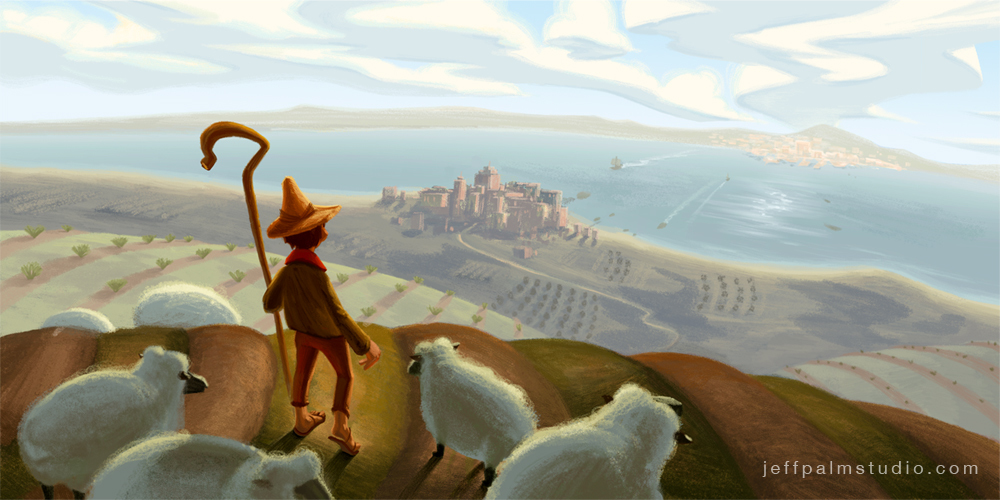
Santiago is a young man living in the region of Andalusia, Spain. He once studied at a seminary in accordance with his family’s wishes, but chose instead to become a shepherd in order to travel freely. Although simple, his life is marked by agency – he reads books, reflects, and observes the world during his journeys with his flock.
Everything changes when Santiago repeatedly dreams of a child leading him to the foot of the Egyptian pyramids and pointing out the location of a treasure. Rather than dismissing it as meaningless, he seeks out a fortune teller to interpret the dream. She affirms that the treasure is real and asks for a share if he finds it.
Shortly afterward, Santiago meets an old man who claims to be the King of Salem – Melchizedek. This figure introduces him to the concept of the “Personal Legend” – that which every person longs to accomplish in youth but gradually abandons out of fear and compromise with circumstance. He gives Santiago two stones, Urim and Thummim, to help him read omens.
Faced with the choice of continuing his familiar life or embarking on a risky journey, Santiago decides to sell his flock, leave Spain, and travel to Africa.
The First Trial – Loss and the Lesson of Adaptation
Upon arriving in Tangier, Morocco, Santiago is robbed by a stranger and loses all his money. Within a single day, he finds himself destitute in a foreign land, without language or possessions. This is the first shock, testing his faith in his dream.
Instead of returning home, Santiago accepts a job working for a crystal merchant. The business has been stagnant because the merchant fears change. Santiago proposes new ideas – displaying crystal outside the shop and serving tea in crystal glasses – and gradually helps the shop prosper.
The nearly one year he spends there marks an important turning point. Santiago learns that destiny does not replace effort; omens have meaning only when a person acts. At the same time, he encounters a contrasting model – the crystal merchant, who once dreamed of making a pilgrimage to Mecca but never fulfills it, fearing that the realization of the dream would leave him with nothing to hope for.
When he has earned enough money to buy back his flock and return to Spain, Santiago once again faces a choice: return to safety or continue toward the pyramids. He chooses to continue.

Crossing the Desert – Confronting War and Learning to Listen to the Universe
Santiago joins a caravan crossing the Sahara Desert on its way to Egypt. Along the journey, he meets an Englishman devoted to the study of alchemy. The Englishman believes the key to transformation lies in books and laboratories; Santiago, in contrast, learns from lived experience and observation.
In the vast desert, war erupts among tribal factions. This harsh environment compels Santiago to learn how to listen to the “Language of the World” – the omens expressed through the movements of nature. Upon reaching the oasis of Al-Fayoum – considered neutral territory among the tribes – Santiago meets Fatima and falls in love with her.
Love introduces a new inner conflict. Staying with Fatima would mean abandoning the journey. Yet Fatima affirms that if love is destiny, it will wait. For the first time, Santiago understands that true love does not obstruct one’s “Personal Legend,” but accompanies it.
At the oasis, Santiago foresees an attack and warns the tribal chieftains. As a result, the oasis avoids disaster. He is rewarded with money and recognition – a sign that he has learned to read omens.
Meeting the Alchemist – The Climax of Transformation
It is at the oasis that Santiago meets the Alchemist – the figure who possesses profound knowledge of transformation. Unlike the Englishman, the Alchemist does not dwell on theory but emphasizes direct experience. He asserts that the key to alchemy lies not in formulas, but in the purification of the soul.
The Alchemist leads Santiago onward through the war-torn desert. Along the way, they are captured by a tribal group. To secure their release, Santiago must prove that he can turn himself into the wind. During three days of contemplation in the desert, he speaks with the wind, the sun, and ultimately the “Soul of the Universe.”
This moment marks the symbolic climax of the novel. Santiago realizes that he is not separate from the world; he is part of the universal whole. When he reaches this awareness, a powerful wind arises – the tribe believes he possesses supernatural power and releases them.
The Pyramids and the Truth About the Treasure
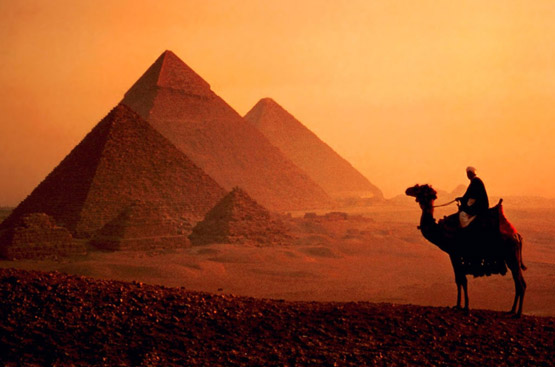
At last, Santiago arrives at the foot of the Egyptian pyramids and begins digging for the treasure. However, he is robbed and beaten once again. While mocking him, one of the thieves recounts a dream about a treasure buried beneath a sycamore tree in a ruined church in Spain – a place where a shepherd often sleeps with his flock.
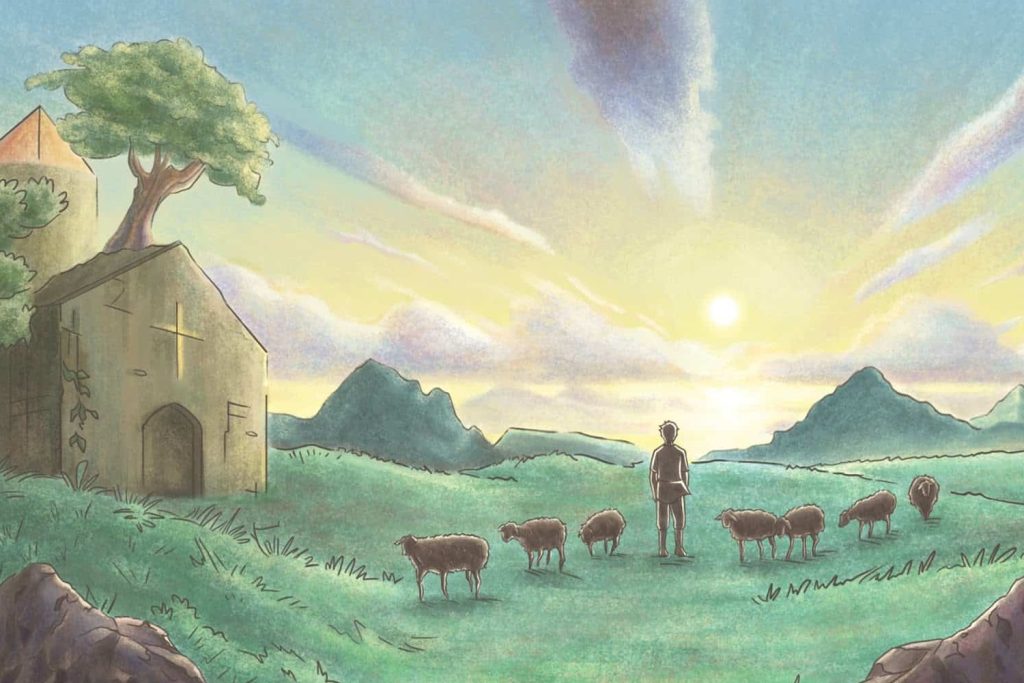
Santiago realizes that this is the very place where his journey began. He returns to Spain and digs beneath the sycamore tree in the abandoned church – where his sheep once rested. There, he truly finds the treasure of gold and precious stones.
The ending affirms a philosophical paradox: the treasure lies at the point of origin, yet it can only be found after one has completed the journey and undergone inner transformation.
3. The Value, Role, and Distinctive Features of The Alchemist – From Modern Parable to Global Cultural Symbol
On the surface, The Alchemist appears to have a simple structure: a young man sets out in search of treasure. Yet this very simplicity is Paulo Coelho’s artistic strategy. He constructs a story that can be read in a few hours, but that is capable of provoking reflection for many years. The value of The Alchemist does not lie in narrative complexity, but in its symbolic depth and its ability to engage universal questions of human life.
The Philosophy of the “Personal Legend” – The Central Intellectual Axis
The concept of the “Personal Legend” is the most prominent intellectual contribution of The Alchemist. As presented in the novel, it refers to the deep dream that each person is born to fulfill. In youth, everyone clearly senses this calling; yet over time, fear, attachment to safety, and social pressure lead them to abandon it.
Notably, Coelho does not portray dreams as merely material ambition. The treasure in the story is symbolic. What truly matters is the process through which Santiago learns to read omens, listen to his heart, and accept risk. Thus, the “Personal Legend” is not only a goal, but a journey of spiritual maturation.
From a philosophical perspective, this idea is akin to the notion of “destiny” in various cultural traditions; however, Coelho places emphasis on individual responsibility. The universe may “conspire,” but the human being must be the one to take the first step.
The Journey as a Model of Spiritual Growth
The journey structure of The Alchemist can be interpreted as a variation of the “hero’s journey” – a model synthesized by scholar Joseph Campbell in mythological theory. Santiago leaves the familiar world, undergoes trials, receives guidance from mentor figures, confronts crisis, and returns with new knowledge.
The difference, however, lies in the nature of his victory. Santiago does not defeat an external enemy; rather, he overcomes fear and doubt within himself. The greatest challenge is not the desert or the thieves, but the temptation to abandon his dream after the first failure.
In the novel, the desert is not merely a geographical space, but a symbol of solitude, trial, and purification. The oasis represents rest and the temptation to remain. The Alchemist embodies inner wisdom, while gold – the ultimate product of alchemy – serves as a metaphor for spiritual completion after transformation.
Alchemy – A Metaphor for Transformation
In ancient tradition, alchemy was the attempt to turn base metals into gold. In The Alchemist, this process is elevated into a symbol of inner transformation. Human beings, like raw metal, must undergo trials and purification to reach “gold” – a state of self-awareness.
Coelho employs this image to emphasize that true value lies not in external accumulation, but in internal change. Santiago begins his journey as a curious young shepherd and concludes it as a person who understands that he is part of the “Soul of the Universe.”
It is precisely this combination of mysticism and universality that prevents the novel from being confined to a specific religious system. The Alchemist harmonizes elements of Christianity, Islam, and Eastern spirituality within an open framework, enabling readers from diverse cultural backgrounds to find resonance.
Simple Language – High Symbolic Effectiveness
One of the distinctive features of The Alchemist is its restrained style. Sentences are short, clear, and free of elaborate description. The narrative rhythm is steady, closer to a parable than to a realist novel.
This simplicity allows the symbolic layer to stand out. Each detail – the stones Urim and Thummim, the crystal tea glasses, the desert wind – carries metaphorical significance. The novel does not provide lengthy analysis; instead, it allows the symbols to operate within the reader’s consciousness.
From the perspective of reception, this style makes The Alchemist accessible to readers of different ages and educational backgrounds, while also facilitating quotation and global circulation.

Cultural Role and Global Influence
Since its publication in 1988 under the original title O Alquimista and its wider recognition through the English edition The Alchemist, the novel has extended beyond the boundaries of literary fiction. It is used in education, quoted in motivational speeches, and referenced across fields ranging from business to personal development.
With more than 65 million copies sold worldwide and translations into over 80 languages, The Alchemist is one of the best-selling books of all time. Its influence lies not only in numbers, but in the formation of a recognizable vocabulary: “Personal Legend,” “Soul of the Universe,” and the idea that “the universe conspires.” These concepts have become part of contemporary cultural discourse.
Strengths and Limitations
In terms of strengths, The Alchemist possesses a coherent structure, consistent symbolism, and a clear message. The work achieves a balance between storytelling and philosophy, between entertainment and reflection.
However, some critics argue that Coelho’s philosophy is highly general and lacks deep social analysis; the characters function more as symbolic figures than as complex individuals. Yet this simplification is a deliberate artistic choice, intended to preserve the novel’s universality and broad accessibility.
Concluding Assessment of Its Value
On the literary level, The Alchemist is a modern parable about the journey toward self-awareness. On the cultural level, it is a global symbol of faith in dreams. On the personal level, it poses a direct question: does one have the courage to pursue what one truly desires?
It is the intersection of these three dimensions that has enabled The Alchemist to sustain its vitality for more than three decades, becoming one of the most influential works of contemporary literature.
4. Reflections and Evaluation of The Alchemist – When a Simple Story Opens into Philosophical Depth
Placed in comparison with many contemporary novels of its time, The Alchemist does not impress through complex narrative techniques or multilayered psychological structures. Paulo Coelho chooses a different path – reducing form in order to foreground ideas. This artistic choice creates a distinctive appeal, while also opening multiple directions for reception and evaluation.

Impression of Structure and Narrative Rhythm
One of the most noticeable aspects when reading The Alchemist is the coherence of its plot organization. Santiago’s journey is divided into clear stages – departure, loss, learning, trial, transformation, and return. There are no superfluous details; each event contributes to the character’s process of awareness.
The narrative rhythm is steady and does not heighten dramatic tension in the manner of a conventional adventure novel. Even moments of tension – such as when Santiago is robbed or when he must prove that he can “turn himself into the wind” – are presented in a restrained tone. This creates a particular effect: rather than focusing on external action, the reader is guided into the inner movement of the character.
It is precisely this restraint that brings The Alchemist closer to a parable than to a realist novel. The work does not aim to reconstruct a specific society, but to build a symbolic space in which each character represents a particular existential choice.
The Appeal of the Message of Pursuing Dreams
One of the factors that has made The Alchemist widely read is its clear and direct message: one must dare to pursue one’s “Personal Legend.” However, a closer reading reveals that the novel does not promote simplistic optimism. Santiago repeatedly faces the possibility of giving up – when he loses his money in Tangier, when he has the chance to return to his flock, when he falls in love with Fatima and wishes to stay.
Each choice involves tangible risk. The emphasis on risk renders the journey more credible. The final success is not portrayed as the result of pure luck, but as the outcome of a continuous chain of decisions in which the character actively confronts fear.
At this point, The Alchemist functions as a text that provokes self-questioning: do people abandon their dreams because of incapacity, or because of fear of failure? The novel does not provide lengthy argumentation, but allows this question to operate within the reader’s own reflection.
Symbolic Depth and Universality
The success of The Alchemist also lies in the universality of its symbolic system. The desert is not merely a desert; it is a space of trial and solitude. The oasis is not simply a resting place; it is the temptation of safety. The Alchemist is not only a character; he represents inner wisdom and transformation.
This symbolic structure transcends cultural boundaries. Whether readers come from Western or Eastern contexts, they can recognize in Santiago’s journey an image of themselves – someone who has hesitated before an important choice, who has weighed safety against risk.
For this reason, The Alchemist is not confined to a specific historical circumstance. The work operates as an open metaphor, allowing each reader to discover meanings aligned with personal experience.

Limitations and Debates
Alongside widespread praise, The Alchemist has also received notable criticism. Some argue that its philosophy is highly general and closer to inspirational literature than to socially analytical fiction. The characters are constructed as symbolic types rather than psychologically complex individuals.
These observations are not without basis. However, the work should be considered in light of its artistic objective. The Alchemist does not seek to reconstruct social reality with multidimensional conflicts, but to focus on a generalized spiritual journey. The simplification of psychological depth is a deliberate choice to preserve the clarity of its symbolic structure.
From this perspective, the limitation of the novel is simultaneously a condition for its broad resonance. The simplicity in character construction enables readers to project their own experiences onto the story.
The Value of Rereading Over Time
A notable characteristic of The Alchemist is its capacity to shift in meaning according to the reader’s age. When read in youth, the work may be received as a powerful encouragement to venture forth. When read at a more mature stage, attention may shift toward themes of choice, responsibility, and the cost of the journey.
The treasure that Santiago ultimately finds is not merely gold and jewels, but the confirmation that the journey has transformed him. This realization gives the novel greater depth than a simple fairy tale about success.
Overall Evaluation
On the artistic level, The Alchemist is a modern parable constructed through a coherent structure and a consistent symbolic system. On the ideological level, it affirms the active role of the individual in creating the meaning of life. On the level of reception, it demonstrates the capacity of literature to connect broadly with the human need for self-examination.
It is precisely the intersection between simplicity and depth that has enabled The Alchemist to sustain its vitality, becoming one of the most frequently mentioned books in discussions of dreams, destiny, and the journey of self-discovery.
5. Memorable Quotations in The Alchemist – When Words Become Declarations of Life
One of the reasons why The Alchemist by Paulo Coelho is widely quoted around the world lies in its system of concise sentences that are highly generalized yet not abstract. The statements in the novel are often short, direct, and memorable – yet behind them stands a coherent intellectual structure concerning dreams, destiny, and individual choice.
1. “When you want something, all the universe conspires in helping you to achieve it.”
→ This is the most famous line in The Alchemist, closely associated with the concept of the “Personal Legend.” The statement not only affirms belief in the support of the “universe,” but also emphasizes a prerequisite: one must genuinely desire and dare to act. The idea that the “universe conspires” does not replace effort; rather, it symbolically expresses the harmony between individual will and the larger flow of life.
2. “It’s the possibility of having a dream come true that makes life interesting.”
→ This line places emphasis on possibility rather than outcome. Life becomes meaningful because the possibility of a dream’s fulfillment exists. Even before achievement is realized, belief in that possibility provides motivation to continue forward. This perspective prioritizes the process over the destination.
3. “There is only one thing that makes a dream impossible to achieve: the fear of failure.”
→ Instead of attributing failure to circumstances or fate, this statement identifies the greatest obstacle as internal – the fear of failure. Throughout Santiago’s journey, fear appears repeatedly: fear of losing money, fear of war, fear of losing love. Recognizing and overcoming fear becomes the condition for the continuation of the journey.
4. “One is loved because one is loved. No reason is needed for loving.”
→ Appearing in the context of Santiago and Fatima, this line defines love as an intrinsic value, independent of benefit or condition. In The Alchemist, love does not stand in opposition to dreams; it does not restrain, but provides spiritual grounding for the journey. The statement affirms that true love does not require the abandonment of one’s “Personal Legend.”
5. “Remember that wherever your heart is, there you will find your treasure.”
→ This is one of the clearest crystallizations of the entire work. The “treasure” does not merely signify material wealth, but symbolizes life’s true value. The heart – that is, intuition and deep aspiration – becomes the guiding compass. If one neglects the heart, one may possess many things yet still fail to find one’s own “treasure.”
6. “Maktub.”
→ This Arabic word means “it is written.” In The Alchemist, “Maktub” appears as a recurring rhythm, evoking the concept of destiny. However, Coelho does not interpret destiny as rigid predetermination. “Maktub” coexists with personal choice: what is “written” becomes reality only when one dares to walk one’s own path.
7. “When we strive to become better than we are, everything around us becomes better too.”
→ This line extends the personal message into a communal dimension. Inner transformation does not affect only the self, but also radiates outward to the surrounding environment. In this way, the novel connects the individual journey to the broader meaning of social life.
8. “Tell your heart that the fear of suffering is worse than the suffering itself.”
→ This statement marks an important stage in Santiago’s maturation as he learns to confront fear. The novel distinguishes between actual suffering and imagined fear. It is often the fear of being hurt that prevents people from beginning, whereas real suffering – if it occurs – becomes part of the process of growth.
6. The Enduring Value of The Alchemist and the Remaining Question for Every Reader
More than three decades after its first publication under the original title O Alquimista, The Alchemist continues to maintain a distinctive position in global reading culture. Not because of a complex plot or groundbreaking narrative techniques, but because the novel touches upon a universal question: do human beings dare to live faithfully according to their deepest dreams?
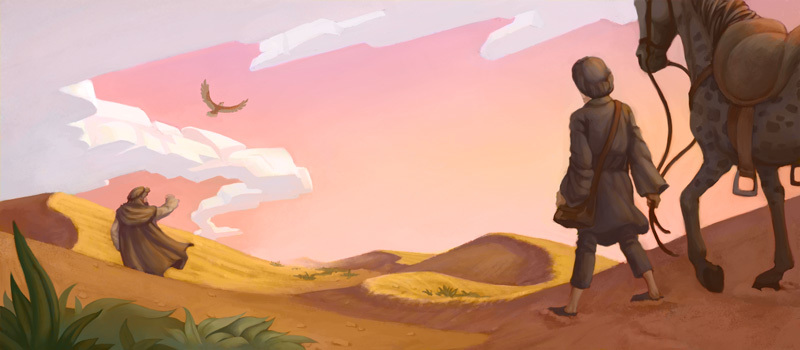
Ultimately, Santiago’s journey is not a quest for gold beneath the Pyramids, but a journey of learning to listen to his heart, confront fear, and accept the cost of his own choices. The material treasure appears only at the end of the story as a symbolic confirmation; the true value lies in the inner transformation the character undergoes. When he returns to his starting point, Santiago is no longer the shepherd boy of the first pages – he has become someone who understands that the meaning of the journey is no less important than the destination itself.
On the literary level, The Alchemist by Paulo Coelho is a modern parable with a coherent structure, clear symbolism, and a consistent philosophy. On the cultural level, the work has become a global symbol of belief in one’s “Personal Legend.” On the personal level, the book poses a serious demand: each individual must determine their own path, rather than living according to expectations or fears shaped by external forces.
The Alchemist does not promise that every dream will be easily achieved. The novel affirms only one thing: if people give up from the very beginning, they will never know how far they might have gone. And when closing the final page, the remaining question is no longer for Santiago, but for every reader – between safe choices and the call from within, will we choose to stay, or will we step forward to seek our own “treasure”?